
How to Check Criminal History in Marion County
There is no single Marion County database that contains every arrest report, booking, court filing, conviction, warrant, and supervision entry. For a known local matter, the Marion Circuit Court Clerk is the best first source because the same office keeps both Circuit Court and District Court case files. Give the clerk a case number when possible. A full name, prior name, and approximate filing year can help when the number is unknown. Ask for the docket and the final order, not just a list of charges.
Use a broader channel when the county or record type is unclear. AOC FastCheck and the mailed AOC-RU-004 search Kentucky court data by name. The jail answers current Marion County custody questions, while KOOL covers Kentucky Department of Corrections custody or supervision. The arresting agency holds its own narrative. Follow these steps:
- Call the Marion Circuit Court Clerk about a known case and confirm whether it is a Circuit or District Court file.
- Ask for the docket, charging document, and charge-level disposition or judgment.
- Use AOC FastCheck or AOC-RU-004 if a statewide Kentucky court-record search is needed.
- Check the detention center for county custody and KOOL for state custody or supervision.
- Request the incident or arrest report from the agency that created it, then order clerk copies when documentary proof is needed.
Note: A name match alone is not biometric proof; compare dates, case numbers, courts, and the final charge-level outcome.
Three Marion County Record Buildings
One Marion County event can produce three records at three custodians. The sheriff or Lebanon Police creates an incident or arrest narrative. The Marion County Detention Center makes a separate booking file after custody transfer. Once a citation, complaint, or indictment is filed, the circuit clerk maintains the court docket and orders. Those documents can describe the same event but answer different questions.
The official Marion County government directory provides the starting point for county offices.

That county directory helps distinguish the judicial, sheriff, and detention channels before a requester sends a record inquiry.
Record flow: Sheriff or police report › detention-center booking › District or Circuit Court file › reported state history or correctional status.
Official Kentucky Background Checks
Kentucky offers several official products, and each has a different scope. The Kentucky State Police Criminal Identification and Records Branch provides a consent-based adult name check by mail or walk-in. It costs $20, requires the subject's permission, and KSP publishes an average mail completion time of 10 business days. KSP states that it does not currently accept that request online.
The Kentucky Administrative Office of the Courts supplies statewide court-record reports through FastCheck and AOC-RU-004. A fingerprint-based self-review is different. KSP 309, rolled fingerprints, and a $20 payment support review of one's own KSP history under 502 KAR 30:070. For checks authorized by a Kentucky statute, the requesting agency gives the applicant an IdentoGO service code. A federal Identity History Summary is a subject-only FBI product.
The KSP page shows the official Marion County criminal-history route and its request limits.

This source makes clear why a court name search should not be described as a fingerprint-confirmed identity history.
| Official product | Method and scope | Published amount |
|---|---|---|
| Marion clerk file | Known local Circuit or District Court case | Ask the clerk for copy or certification charges |
| AOC-RU-004 | Name-based Kentucky court report | $25 request |
| KSP adult name check | Consent-based adult Kentucky history by mail or walk-in | $20 |
| KSP own-record review | KSP 309 with rolled fingerprints | $20 plus any print-taking cost |
| FBI Identity History Summary | Fingerprint-supported subject self-review | $18 FBI fee |
Marion Court Reports Versus Rap Sheets
AOC FastCheck searches Kentucky court information by identifiers such as a name and date of birth. It offers statewide breadth, but it is not the local documentary file and is not biometric. Common names, aliases, and missing identifiers can affect matching. The Marion County clerk can supply pleadings, orders, docket entries, and the judgment in a known case, which a compact statewide report does not reproduce in full.
A KSP repository history groups identity-linked arrest cycles and dispositions reported by contributing agencies. A lag or unmatched identifier can leave a disposition incomplete. When reviewing one's own record, compare the repository entry with the Marion County final order. KSP's challenge process uses KSP 310 within 30 working days of review and supporting source documents. If the error began with a contributing agency, KSP routes the issue back to that source.
The Kentucky Court of Justice entry page links its case, background-check, expungement, and forms services.
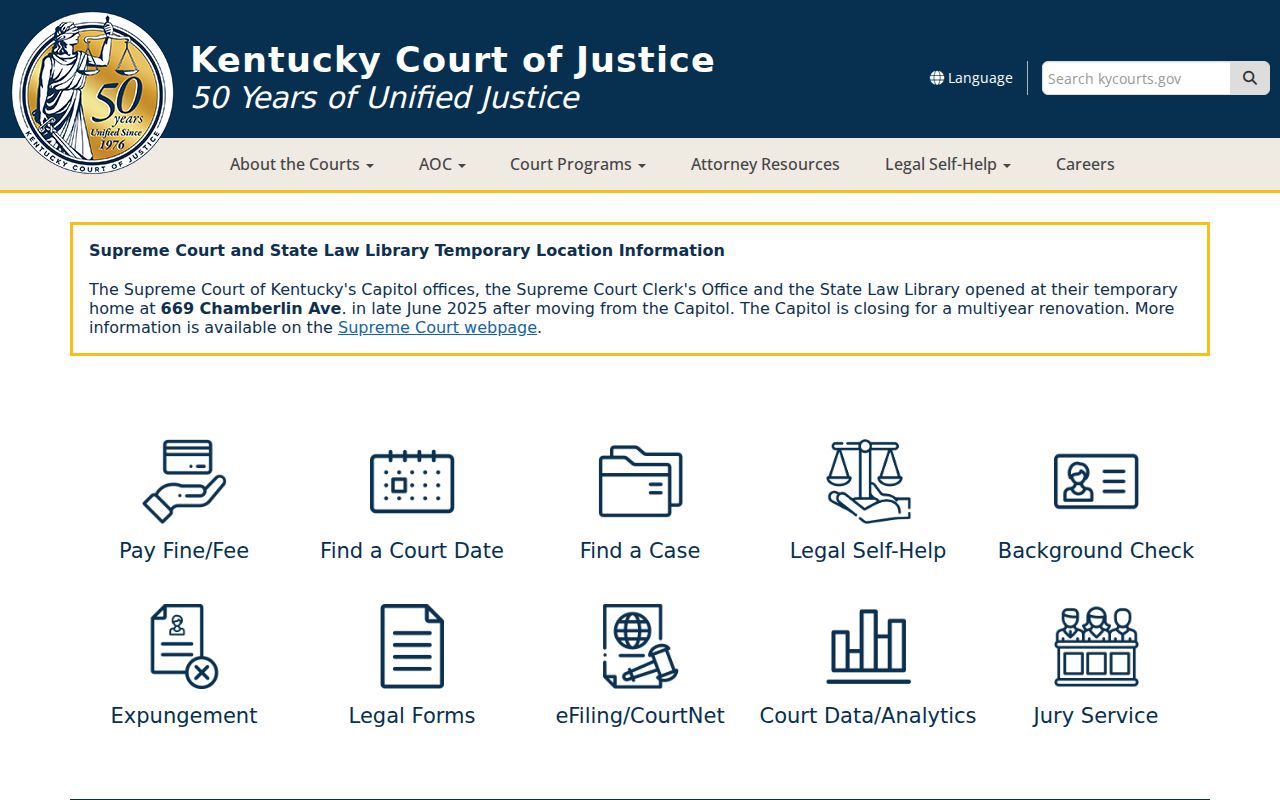
Those judicial services complement Marion County records; they do not replace the clerk as custodian of the underlying local case file.
Types of Criminal Records
Marion County criminal records are made at different stages. An incident report describes the first agency response. An arrest report documents the legal basis and custody transfer. Jail staff then create a booking record with intake identifiers and charges. The court file follows the prosecution and holds the final judicial outcome. Repository and corrections systems receive selected facts for their own purposes.
- Arrest and booking records: the arresting agency keeps its narrative, while the detention center keeps intake and custody data.
- Criminal court case files: the Marion Circuit Court Clerk maintains filings, dockets, orders, judgments, and sentence records.
- Repository histories: KSP groups reported arrest events and dispositions around identity records.
- Warrants: a court issues the process, and public confirmation should come from the sheriff or clerk.
- Correctional and registry records: KOOL and the KSP Sex Offender Registry are separate purpose-built state systems.
A record's source matters. A booking charge is an allegation at intake. The court file can later show amendment, dismissal, acquittal, plea, verdict, or sentence.
No Public Marion Booking Search
Official sources did not reveal a public Marion County daily booking log or arrest blotter. A blank web search is therefore not proof that no arrest occurred. Call the Marion County Detention Center for current custody and booking-number confirmation. Ask its records custodian in writing for releasable booking material when phone information is not enough. The arresting agency must be contacted separately for the narrative.
The official detention-center page supplies Marion County custody contact information.
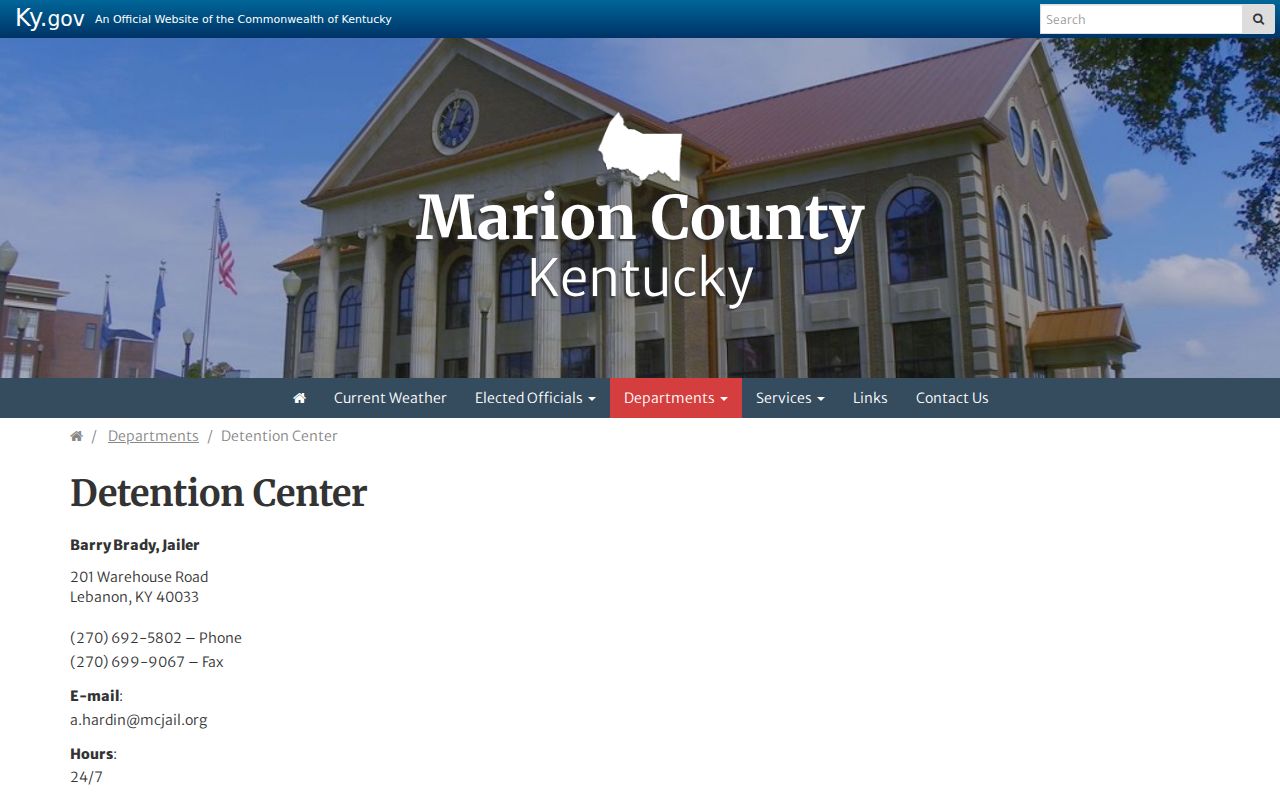
The detention center record is a custody snapshot, so a reader should still obtain the clerk's complaint, bond order, and later disposition.
A Kentucky DOC inmate may be housed in a county jail, which can make KOOL useful. Kentucky VINE may also provide covered custody-status notice. Neither system is a complete list of Marion County arrests. For the fuller arrest-channel workflow, see the Marion County arrest history record page.
What a Marion County Criminal Record Shows
The fields depend on the custodian. A Marion County court file identifies the court, case number, parties, charges, events, and charge-level dispositions. A booking record adds intake details. KOOL can display DOC or person identifiers, status, location, aliases, conviction entries, and sentence-related dates. Private medical, classification, victim, and personal-identifier data may be withheld.
| Name & Identifiers | Party name, aliases when recorded, case number, booking number, PID, or DOC number, depending on the source. |
|---|---|
| Arrest / Booking Data | Agency, event date, legal basis, intake time, booking charge, bond, custody, and release fields when public. |
| Charges & Statutes | Count number, offense text, Kentucky statute code, and class recorded at that stage. |
| Disposition | The outcome for each count, including dismissal, acquittal, plea, verdict, or other final action. |
| Sentence | Term, concurrent or consecutive treatment, probation, fines, costs, restitution, and related orders when imposed. |
| Custody / Supervision Status | County custody, DOC location, probation or parole status, and release-related dates where authorized for public display. |
One case can contain several counts with different outcomes. Read each line rather than treating the case heading as one blanket result.
KOOL Filters for Marion County Records
The Kentucky Online Offender Lookup is the public locator for Kentucky DOC custody or supervision. Start with little information, then add filters if the list is broad. Name fields, alias search, DOC and PID numbers, supervision status, location, county of supervision, age, offense, statute, indictment, conviction county, and several date ranges may be available.
| KOOL field | Type | Required | Use |
|---|---|---|---|
| Last / First / Middle Name | Text | No | Begin with minimal spelling; first and middle names can narrow results. |
| Search Aliases | Checkbox | No | Includes recorded alternate names. |
| DOC # / PID # | Text | No | Uses correctional locator numbers instead of a common name. |
| Supervision Status | Dropdown | No | Narrows the status shown by DOC. |
| County of Supervision | Dropdown | No | Filters public supervision data by county. |
| Conviction County | Dropdown | No | Focuses conviction entries by Kentucky county. |
KOOL warns that data newer than 120 days may not be finalized. A no-result search should be reset and tried with less data. Confirm a Marion County outcome in the clerk's judgment because KOOL is not a local court-file viewer.
Public Access Laws
The Kentucky Open Records Act governs agency records such as sheriff reports and jail documents, while the circuit clerk is the legal custodian of local court case files. Public access is not absolute. Protected personal data, juvenile material, parts of active investigations, and records made confidential by another law can be redacted or withheld.
Key Statutes:
KRS 61.870 defines public agencies and public records under the Kentucky Open Records Act.
KRS 61.872 sets the process for inspecting and copying nonexempt public records.
KRS 61.878 lists exceptions for privacy, investigations, and other protected material.
KRS 431.076 governs expungement after an acquittal, qualifying dismissal, or no indictment.
KRS 431.073 controls vacation and expungement for specified eligible felony convictions.
Ask the office that created or holds the record. A denial of an agency-record request must cite the exception and explain how it applies.
Marion Sheriff Record Requests
The Office of Marion County Sheriff accepts record inquiries at Suite 101 of the David R. Hourigan Government Center, 223 N. Spalding Ave., Lebanon. The office phone is 270-692-3051, fax is 270-692-4389, and email is mcso223@marioncountyky.gov. Published weekday hours are 8:30 a.m. to 4:30 p.m. No verified separate records portal, copy schedule, or standard turnaround was found, so request an estimate before ordering a large file or media.
The official sheriff website is the county source for sheriff services and records contact context.

This channel covers sheriff-created material, not a Lebanon Police narrative or the detention center's booking file.
A written request should name the record, date, approximate time, place, agency, and report number if known. State whether inspection, an electronic copy, or paper is preferred. For CAD logs, 911 audio, or body-camera video, name the specific media and narrow the time span. Ask for an itemized estimate and keep proof of submission.
Sealed, Expunged & Restricted
Juvenile matters, expunged cases, protected victim and minor identifiers, financial-account numbers, medical data, and parts of an active investigation may not appear in ordinary public results. A docket can remain public while a specific exhibit or identifier is sealed. A missing online result can also reflect a stored file, reporting lag, or incomplete name match, so it does not prove that no record exists.
Kentucky has different expungement rules for acquittals or qualifying dismissals, eligible misdemeanors and violations, and specified felony convictions. Relief is filed in the original Marion County criminal case. The court order is what directs the clerk, AOC, KSP, jail, and other contributing agencies to restrict or remove eligible material. The certification alone is not that order.
Marion Expungement Starts With Certification
The Kentucky Court of Justice forms catalog identifies AOC-RU-009, the Expungement Certification Request. The certification costs $40 and expires 30 days after completion, so timing matters. It identifies the person, prior names, date of birth, delivery information, certification type, and payment. Download the current revision rather than relying on an old copy.
The forms catalog supplies the live filing forms, while the official Marion court page identifies the local clerk and filing counter.
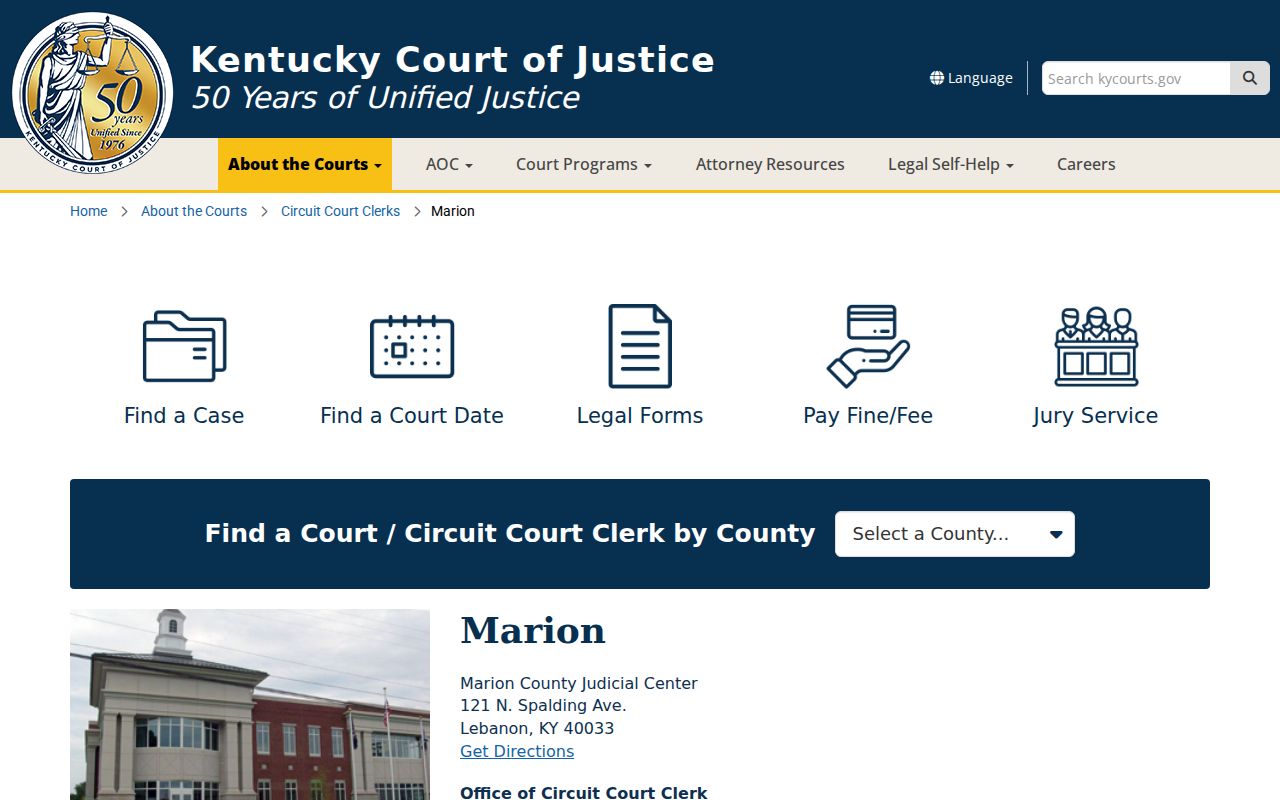
After certification, file the correct application in the original Marion County case at that clerk's office and follow the current statute for the disposition.
Current court guidance states a $100 filing fee per eligible misdemeanor, violation, or traffic-conviction case. Most eligible Class D felony applications have a five-year wait after sentence or supervision completion, use AOC-496.3, and carry a $50 nonrefundable filing payment plus $250 if relief is granted. Other paths have different forms, waits, and fees. After entry of an order, allow time for each system to update and use source-agency correction steps if stale data remains.
Criminal Records by City in Marion County
Marion County has three incorporated cities: Lebanon, Loretto, and Bradfordsville. Lebanon has a documented police department with its own records clerks, so a city incident begins there. Loretto has no verified local police records portal, and Bradfordsville publishes a police-chief phone line but no records unit or search tool. All three route filed criminal and traffic matters to Kentucky District or Circuit Court rather than separate municipal criminal courts.
The official Lebanon Police Department page explains the largest city's local police channel.
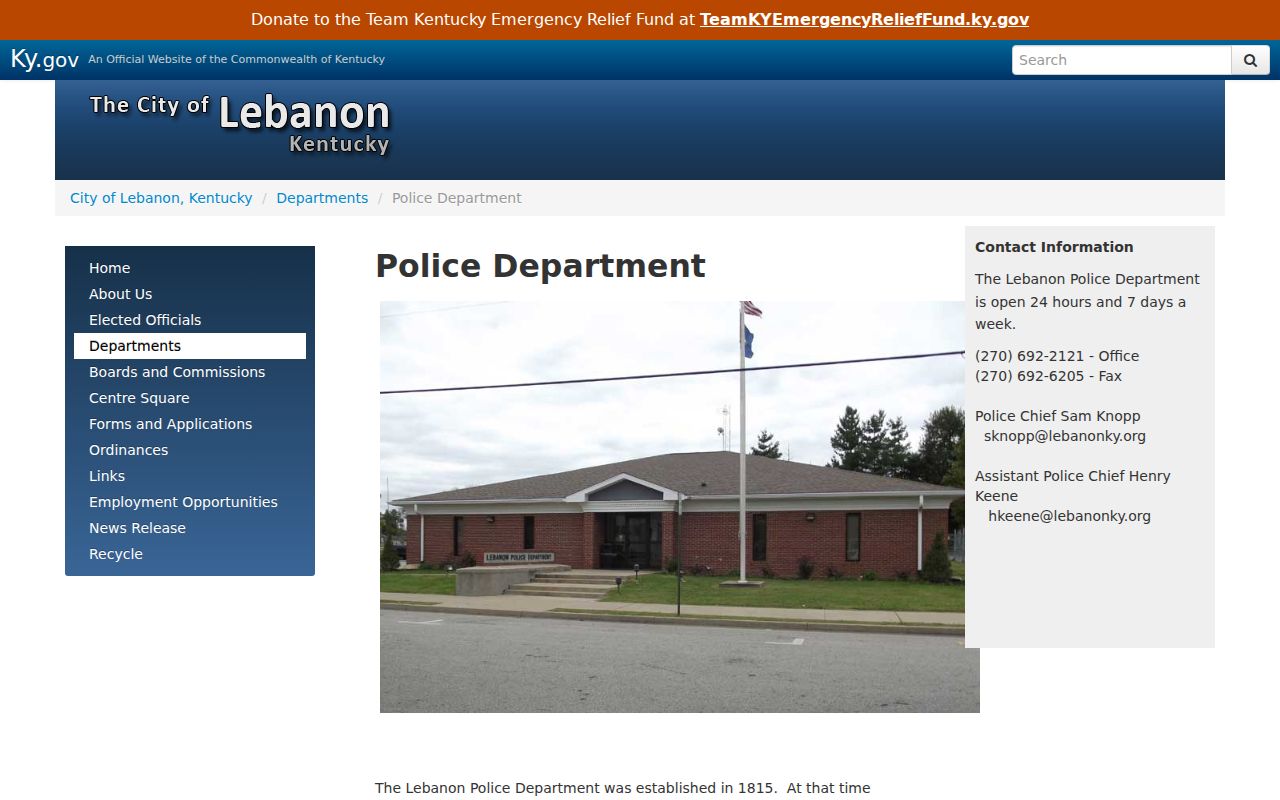
Lebanon police reports remain distinct from Marion County jail bookings and the clerk's court outcomes.
Lebanon Criminal History
6,274 · City police reports begin with Lebanon records clerks; court outcomes remain with the Marion clerk.
Loretto Criminal History
723 · Identify the responding sheriff or KSP unit, then use the Marion court and jail channels.
Bradfordsville Criminal History
270 · Start with the published police-chief line or city clerk, then trace the county court record.
Marion CourtNet Counts Need Context
Official AOC analytics recorded 539 Marion County criminal cases from 2017 through 2021 in which possession of a controlled substance was the highest charge: 86 in 2017, 143 in 2018, 115 in 2019, 81 in 2020, and 114 in 2021. Those numbers describe cases, not unique people. A case can also contain more than one charge, and the listed highest charge is not a complete account of every count or outcome.
The same caution applies to arrest and offense tables. Kentucky's 2024 report counted 2,208 arrests countywide, but arrests are not convictions and may not equal unique people. Agency columns can overlap during joint work. For an individual Marion County criminal record, return to the case number and read the charge-level dispositions instead of drawing a conclusion from countywide totals.